Types of corrosion
The main forms of corrosion explained — uniform, galvanic, pitting, crevice, intergranular, stress-corrosion cracking, erosion-corrosion and dealloying — with how to recognise and defend against each.
Eight ways metal fails
Corrosion engineers traditionally group attack into eight classic forms, a scheme set out by Mars Fontana that still organises the field today. They differ not in chemistry — all are electrochemical — but in *where* and *how* the metal is lost: evenly across a surface, or hidden in a pit, a crevice, or a crack.
The distinction matters enormously. Uniform corrosion is predictable and easy to allow for; localised forms like pitting and stress-corrosion cracking can perforate or snap a component while 99% of it still looks perfect. Recognising the form is how you choose the right defence.
A field guide to corrosion forms
Uniform
Even, predictable thinning across the whole surface — the most common and the most manageable. General rusting of bare steel is the classic case.
Galvanic
When two different metals touch in an electrolyte, the more active one corrodes faster while the nobler one is protected.
Pitting
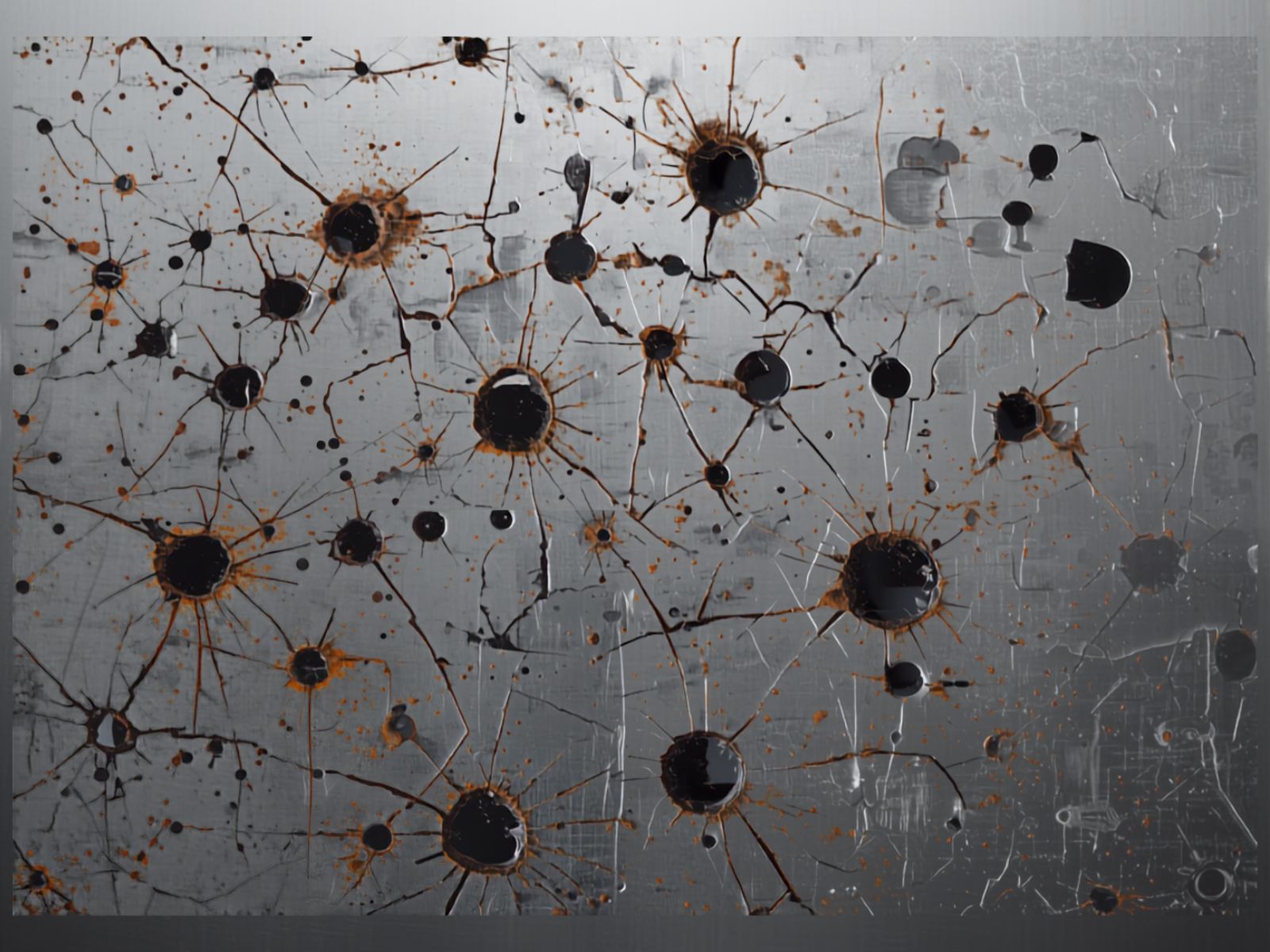
Tiny, deep holes that bore into the metal, often through a damaged passive film. Dangerous because the loss hides below a sound-looking surface.
Crevice
Concentrated attack in shielded gaps — under gaskets, washers, deposits — where stagnant, oxygen-starved solution turns aggressive.
Intergranular
Attack that runs along grain boundaries, classically in sensitised stainless steel where chromium-depleted zones corrode preferentially.
Stress-corrosion cracking
Brittle cracks from the combination of tensile stress and a specific corrosive environment — failure with almost no metal loss.
Erosion-corrosion
Flowing or turbulent fluid strips protective films and sweeps metal away — common in pumps, elbows and impellers.
Dealloying
Selective removal of one element from an alloy, such as dezincification of brass, leaving a weak, porous skeleton behind.
Recognise it, then defend it
Each form has a signature and a preferred countermeasure. Most defences are covered in detail under corrosion protection.
| Form | Where it shows up | First line of defence |
|---|---|---|
| Uniform | Bare steel outdoors, tanks, structures | Coatings, weathering steel, corrosion allowance |
| Galvanic | Mixed-metal joints, fasteners | Isolation, compatible metals, coatings |
| Pitting | Stainless in chlorides, marine parts | Higher-alloy steel, clean surfaces |
| Crevice | Flanges, gaskets, under deposits | Sealed joints, drainage, design |
| Intergranular | Welded stainless steel | Low-carbon or stabilised grades |
| SCC | Stressed parts in specific media | Stress relief, material selection |
| Erosion-corrosion | Pumps, pipe bends, impellers | Harder alloys, lower velocity |
| Dealloying | Brass fittings, valves | Inhibited or resistant alloys |
Modern practice adds others worth knowing: microbiologically influenced corrosion (MIC), driven by bacteria in pipelines and tanks; corrosion fatigue, where cyclic loading and corrosion compound each other; and atmospheric corrosion, the everyday weathering of metal in air — covered in depth on its own page.
Telling the forms apart
Which type of corrosion is most dangerous?
The localised forms — pitting, crevice corrosion and stress-corrosion cracking — are the most dangerous, because they cause sudden failure with very little overall metal loss and often no visible warning.
What is galvanic corrosion?
Galvanic corrosion happens when two dissimilar metals are electrically connected in a wet environment. The less noble metal becomes the anode and corrodes faster than it would alone, while the nobler metal is protected.
How do I know which form I have?
By appearance and location: even dulling points to uniform attack; isolated holes to pitting; cracking under stress to SCC. A corrosion engineer confirms it with microscopy and knowledge of the service environment.
Go deeper than a web page
Failure-analysis workshops and corrosion short courses go far beyond an overview. Corrosion Congress lists them worldwide, from AMPP certifications to specialist pitting and SCC seminars.